Introduction: Why "Design System vs Style Guide" Matters for Enterprises
The debate around design system vs style guide isn't just semantic - it's a critical enterprise decision. Many organizations believe they have a design system, but in reality, they're operating with a brand style guide that can't support scale.
As product portfolios grow, teams multiply, and delivery cycles shorten, enterprises begin to experience friction: inconsistent UI, duplicated work, slower releases, and rising UX debt. These challenges often emerge alongside broader platform and delivery issues, especially when organizations lack a shared foundation for product development.
Companies investing in modern Design System Services often discover that consistency isn't just a design concern - it's an operational and business challenge.
This article explains what each approach offers, where style guides fail, and why enterprises increasingly invest in scalable design systems for long-term ROI.
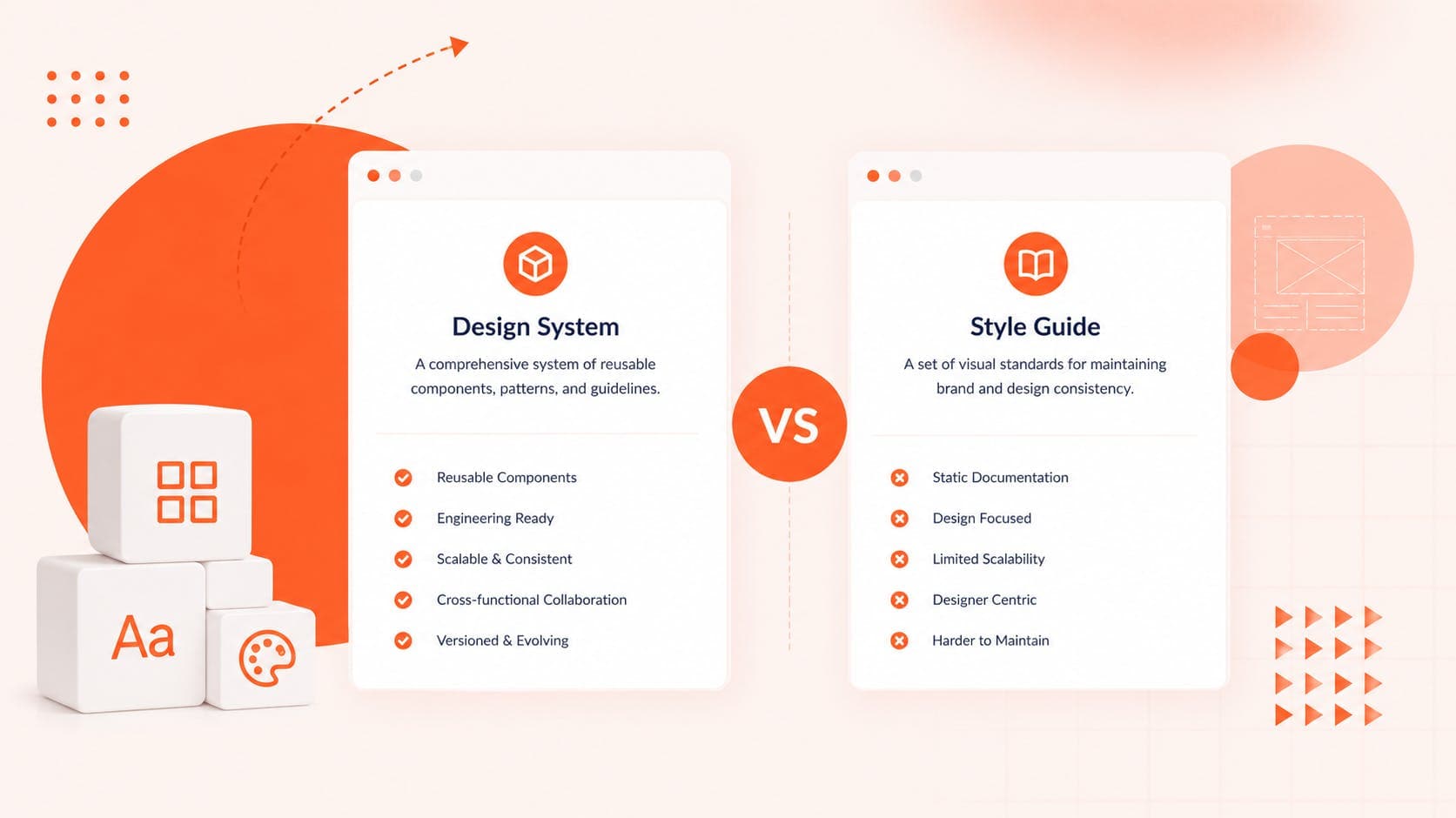
Design System vs Style Guide: The Fundamental Difference
At a surface level, both aim to create consistency. At an enterprise level, their impact is fundamentally different.
A style guide documents visual standards.
A design system operationalizes design at scale.
This distinction is why the design system vs style guide for enterprises conversation exists at all. Design systems move beyond documentation into executable systems that teams can actually build with.
Industry-leading examples such as Google's Material Design (https://m3.material.io/) and IBM's Carbon Design System (https://carbondesignsystem.com/) demonstrate how modern organizations use design systems as product infrastructure rather than documentation repositories.
What Is a Style Guide?
A style guide (often called a brand style guide) defines how a brand looks and feels. It typically includes:
- Brand colors and typography
- Logo usage
- UI element styling
- Spacing and layout rules
Style guides are static by nature. They work well for branding and marketing alignment but struggle as a design system for large organizations.
Where Style Guides Work
- Early-stage products
- Small, centralized teams
- Marketing-heavy initiatives
Where Style Guides Break Down
- Multiple product teams
- Independent engineering squads
- Rapid iteration cycles
- Enterprise UX governance requirements
While style guides help create visual consistency, they rarely provide the structure needed for scalable product development.
What Is a Design System?
A design system is a complete product design system that combines design, code, and governance into a single source of truth.
A mature UX design system includes:
- Design tokens (color, spacing, typography as variables)
- Reusable design system components
- Accessibility standards built into workflows
- Clear contribution and ownership models
- Integration with design and engineering processes
Unlike a style guide, a design system evolves continuously. This makes it the foundation for enterprises aiming to scale product teams without sacrificing quality.
Organizations modernizing digital platforms often combine design system initiatives with broader Software Engineering Services to create stronger alignment between design and development teams.
Design System vs Style Guide Comparison
| Area | Style Guide | Design System |
|---|
| Purpose | Visual consistency | Scalable product delivery |
| Scope | Brand and UI rules | Design, code, and governance |
| Format | Static documentation | Living system |
| Engineering Alignment | Low | High |
| Accessibility | Manual | Built-in |
| Reusability | Limited | Core principle |
| Enterprise Readiness | Weak | Strong |
This comparison clearly illustrates why enterprises eventually outgrow static documentation.
Why Style Guides Fail at Enterprise Scale
1. No Real Reuse
Style guides describe components but don't provide them. Teams repeatedly rebuild the same UI patterns, increasing inconsistency, technical debt, and development costs.
2. Weak Design Governance
Without enforceable standards, governance becomes manual, slow, and difficult to scale across multiple teams, business units, and geographies.
Organizations frequently address this challenge through stronger operational frameworks supported by strategic CTO Services.
3. Engineering Disconnect
Developers often interpret guidelines differently, leading to implementation drift. A product design system eliminates ambiguity by providing production-ready components that integrate directly into engineering workflows.
4. Poor ROI Over Time
This is where design system vs style guide ROI becomes clear. Style guides appear less expensive initially but create compounding inefficiencies as organizations grow.
The result is similar to many short-term technical decisions that seem cost-effective upfront but become expensive to maintain at scale.
Benefits of Design Systems Over Style Guides
Enterprises adopt design systems because they deliver measurable outcomes:
- Faster product delivery through reusable components
- UX consistency across products and platforms
- Lower long-term costs through reduced rework
- Improved accessibility and compliance
- Faster onboarding for designers and engineers
- More effective governance and collaboration
Many organizations combine design systems with AI Automation Services to further improve governance, quality assurance, and workflow efficiency.
These benefits closely mirror the outcomes enterprises seek when modernizing development processes, infrastructure, and digital operations.
When to Use a Design System vs Style Guide
A Style Guide Is Enough If:
- You have a single product
- Teams are small and tightly aligned
- Change frequency is relatively low
You Need a Design System If:
- You manage multiple products or platforms
- Teams ship independently
- You prioritize UX consistency and speed
- You need a framework for scaling product teams
- Accessibility and governance are business requirements
Many enterprises reach this decision point as product ecosystems become more complex and coordination costs begin to outweigh implementation costs.
Design Maturity: From Style Guide to Enterprise Design System
A typical design maturity model follows this progression:
- Brand style guide
- Shared UI components
- Design tokens
- Governance and contribution workflows
- Fully scalable enterprise design system
Organizations often fail when they stop at step one but expect step five outcomes.
Mature systems also align closely with accessibility standards such as the Web Content Accessibility Guidelines and governance models promoted by the U.S. Web Design System.
Conclusion: Why Enterprises Move from Style Guides to Design Systems
The transition from style guides to design systems is a natural evolution. As organizations grow, the limitations of static documentation become increasingly difficult to ignore.
In the design system vs style guide for UX consistency debate, the answer is clear: style guides explain; design systems enable.
For enterprises focused on scale, speed, accessibility, and long-term product quality, investing in a design system isn't merely a design decision - it's a strategic business investment.
Organizations ready to modernize their design operations can explore Beyond Labs' Design System Services, review real-world implementation examples in our Case Studies, or connect with our team through the Contact Page to discuss enterprise design system strategy.