Product-Led Growth for B2B SaaS: A Complete Framework
A step-by-step product-led growth framework for B2B SaaS: choose your motion, define activation, build PQLs, and use benchmarks from 600+ companies.
Sachin Rathor
9 Oct 2026
7 min read
Product-led growth (PLG) sounds simple: let the product do the selling. In practice, most B2B SaaS teams that try it end up with a free plan nobody upgrades from, a trial nobody finishes, or a sales team that never sees the right leads.
This guide gives you a complete product-led growth framework for B2B SaaS: what PLG actually requires, how to choose between freemium and a free trial, how to define activation and product-qualified leads (PQLs), which benchmarks to hold yourself to, and a step-by-step plan to implement it. It draws on a survey of 600+ SaaS companies and on the practices of teams that have run PLG at scale.
The short version
PLG means the product itself drives acquisition, conversion and expansion. Marketing and sales support it instead of replacing it.
It works best when users can reach value on their own, quickly, without a demo.
Pick a motion (freemium, free trial or reverse trial) based on how fast value arrives and how much each user costs you.
Measure activation first. Then build product-qualified lead (PQL) signals so sales talks to users who are already succeeding.
Most B2B companies end up with a hybrid: product-led onboarding plus sales-assist for larger accounts.
What product-led growth means in B2B SaaS
In a sales-led company, a prospect hears about the product from marketing or outbound, talks to sales, sees a demo and then gets access. In a product-led company, the prospect gets access first. They use the product, experience value, and then either pay on their own or are introduced to sales because their usage shows buying intent.
The term was popularized by Wes Bush in his book “Product-Led Growth: How to Build a Product That Sells Itself” and is now widely used across SaaS. For a practitioner's view on what separates PLG companies that succeed from those that stall, listen to the conversation with growth leader Elena Verna below.
Is PLG right for your product?
PLG is a go-to-market model, not a growth hack, and it makes demands on the product. Before committing, check these conditions:
Time to value is short. A new user can reach a meaningful result in minutes or hours, not weeks of implementation.
Self-serve is possible. Setup does not require security reviews, custom integrations or a services team in the first session.
Value is visible to the user alone. One person can benefit before the whole company is on board.
There is a natural expansion path. More users, more usage or more features create a reason to pay more.
Unit economics survive free users. Serving non-paying users must not cost more than the conversions justify.
If your product needs weeks of data integration before the first result, a pure PLG motion is a poor fit. A sales-led or sales-assisted model, with a product-led trial layered on top, tends to work better.
PLG vs sales-led vs product-led sales
Dimension
Sales-led
Product-led growth
Product-led sales (hybrid)
First touch
Demo or sales call
Sign up and use
Sign up and use
Who converts the user
Sales rep
The product (self-serve checkout)
Self-serve first, then sales on qualified accounts
Typical deal size
Mid to large
Small to mid
Mid to large, grown from a small start
Time to value
Weeks to months
Minutes to days
Days to weeks
Key lead signal
Marketing qualified lead
Activation
Product-qualified lead
Main risk
Slow sales cycles, high CAC
Free users who never pay
Misaligned handoff between product and sales
Step 1: Choose your PLG motion
There are three common entry models. The right one depends on how fast value arrives and how much a free user costs you.
Model
How it works
Best for
Watch out for
Freemium
Free plan with limits, paid plans unlock more
Products with network effects or low serving cost per user
Large free base that never upgrades
Free trial
Full product for a fixed period, then pay
Products where full value needs the whole feature set
Users who run out of time before activating
Reverse trial
Start on a paid plan for a period, then downgrade to free
Teams that want freemium reach with trial-level activation
Needs clear communication of what is lost on downgrade
The ProductLed survey of 600+ SaaS companies found that 75% of companies adopting PLG start with a free trial or freemium model, and that freemium converted visitors to free accounts at a median of 12%, about 140% higher than free trials. Their PLG benchmarks report has the full breakdown. Higher top-of-funnel conversion is not the same as more revenue, though, so keep the next steps in mind.
Step 2: Define activation, your most important metric
Activation is the moment a new user first experiences the value you promised. It is almost always a specific behavior, not a page view. Examples include creating a first project, connecting a data source, or sending a first invite.
To find yours, compare users who became paying customers with users who signed up and disappeared, then look for the early action they share. Write it down as a testable statement, such as: users who invite a teammate within seven days convert to paid at a higher rate than those who do not. Then check whether that holds in your data.
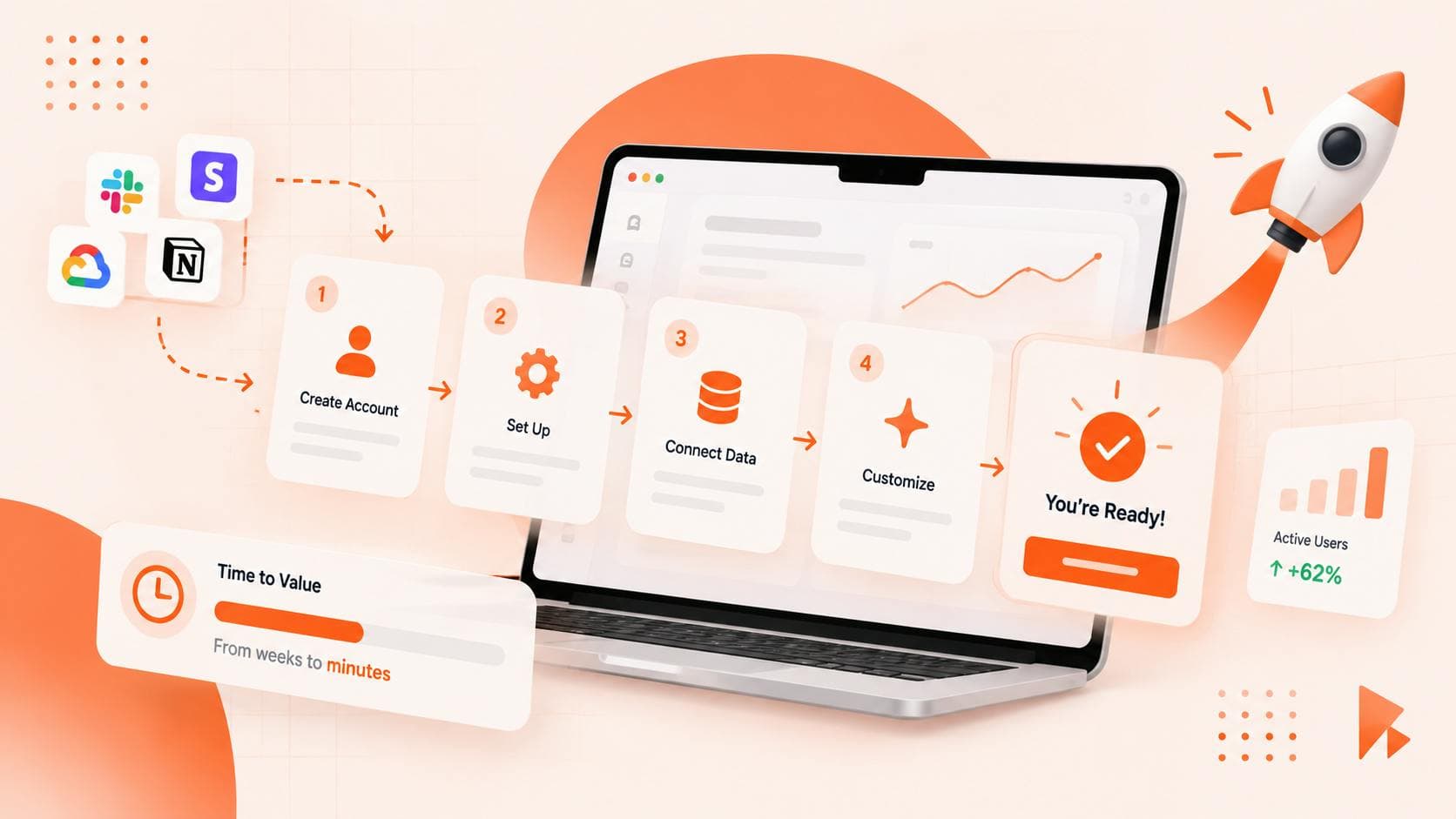
The same survey reported that companies track activation only about 34% of the time, which means measuring it properly already puts you ahead. Once defined, your onboarding has one job: raise the share of new users who reach that action quickly. Our guide to SaaS onboarding and time to value covers how to design that flow.
Step 3: Build the product-led funnel
Acquisition: let the product create the top of the funnel
Product-led acquisition comes from sharing, templates, integrations, public pages and content. A collaboration tool spreads when users invite coworkers. A reporting tool spreads when users share a link to a dashboard. Look at your product and ask which moments naturally put it in front of someone new, then make those moments better.
Onboarding: shorten the path to the activation event
Remove every step that does not lead to activation. Use templates and sample data so the first screen is not empty. Ask one question at signup and personalize with the answer. Keep signup fields to the minimum. If you are building the first version of the product, a lean build gets you here faster; see how to build a SaaS MVP in 30 days using AI.
Conversion: ask for money at the moment of value
Show the upgrade prompt when a user hits a meaningful limit or completes a success milestone, not on day one. Make checkout self-serve, with clear plan comparisons. Pricing structure matters as much as the prompt, so review our guide to SaaS pricing models and mistakes before you finalize plans. For trial products specifically, see how to convert free trial users into paying customers.
Expansion: grow accounts inside the product
In B2B, the biggest revenue often comes from expansion: more seats, more usage, more features. Build seat invitations, usage-based tiers and team-level features so growth inside an account happens through the product, with sales stepping in when an account becomes large.
Step 4: Add product-qualified leads for sales assist
A product-qualified lead (PQL) is a user or account whose behavior suggests they are ready to buy or expand. It is a better signal than a form fill, because it reflects what the person actually did.
According to the ProductLed survey, only around a quarter of product-led companies use PQLs, yet those that do see free-to-paid conversion about three times higher. For products with a contract value of $1K to $5K, the survey reports PQL-driven conversion around 30%, and around 39% for the $5K to $10K band. Those are figures from one survey, so treat them as a reference range, not a promise.
A simple PQL definition combines three kinds of signals:
Activation: the account reached the activation event.
Depth or breadth: several users, or heavy use of a core feature.
Fit: a company size or role that matches your ideal customer profile.
Start with a rough definition, route those accounts to a salesperson with the context of what they did, and check after a quarter whether PQLs closed at a better rate than other leads. Adjust the thresholds from the result.
If you are far below, check activation before pricing
Free-to-paid, $1K to $5K contract value
About 10% (highest median band)
Compare against products at your price point
Visitor to free account, freemium
About 12%
Test signup friction and landing page clarity
Companies using PQLs
About a quarter
An easy advantage if you build the signals
Companies tracking activation
About 34%
Instrument it first
Step 5: Align the team around the product
PLG changes how teams work together. Product owns activation and the in-app experience. Marketing owns top-of-funnel and lifecycle messaging. Sales moves from convincing people to helping already-engaged accounts buy. Growth reviews should share one dashboard that shows activation, free-to-paid conversion, PQL volume and expansion revenue, so no team optimizes its own number at the expense of the others.
A 90-day PLG implementation plan
Weeks 1–2: define the activation event from your data. Instrument it and report the activation rate weekly.
Weeks 3–4: audit signup and onboarding. Remove steps, add templates and sample data, and add one behavior-triggered email.
Weeks 5–6: choose or refine your entry model (freemium, free trial or reverse trial). Set limits that line up with value moments.
Weeks 7–8: add in-product upgrade prompts at success milestones and make checkout self-serve.
Weeks 9–10: define a first PQL rule and route PQLs to sales with usage context.
Weeks 11–12: review cohort data. Compare PQL conversion to other leads, and tune activation and PQL thresholds.
Common PLG mistakes
Copying a competitor's free plan. Their limits fit their costs and value moments, not yours.
Optimizing signups instead of activation. More signups from a leaky onboarding flow just raise your serving costs.
Gating the aha moment. If the feature that creates value sits behind the paywall, free users never see it.
Ignoring sales. Pure self-serve rarely captures larger accounts. Design the handoff deliberately.
Skipping instrumentation. Without event tracking you cannot define activation or PQLs.
Frequently asked questions
What is a product-led growth framework?
It is a repeatable set of steps for letting the product drive acquisition, conversion and expansion: choose a motion, define activation, build the funnel, add product-qualified leads for sales assist, and align the team around shared metrics.
Is PLG only for low-priced products?
No. Many B2B companies use PLG to land small teams and then expand into larger contracts, often combined with sales for big accounts. It does depend on the product being usable without heavy implementation.
Freemium or free trial: which converts better?
Freemium tends to bring more people in at the top of the funnel, while free trials create urgency. Which gives more revenue depends on your product, so test with your own cohorts rather than relying on averages.
What is a product-qualified lead?
A PQL is a user or account that shows buying intent through in-product behavior, such as reaching activation, using key features repeatedly or inviting several teammates, combined with a good customer fit.
How long does it take to see results from PLG?
Onboarding and activation improvements show up within weeks. Revenue effects from conversion and expansion take a few quarters, since you need enough cohorts to compare.
Final thoughts
A product-led growth framework for B2B SaaS comes down to a few disciplined moves: make value fast and visible, measure activation, ask for payment when users succeed, and let sales help the accounts that are already winning. Start with activation, because every later step depends on it.
If you are planning a product-led SaaS and want a team to design and build the self-serve experience, Beyond Labs works with founders from MVP to scale. Explore our services, or read how to get your first 100 SaaS users to feed the top of your funnel.
Beyond Labs LLC provides the information on this website for general informational purposes only and nothing herein constitutes professional, legal, financial, investment, or contractual advice, nor does it create a client relationship; all services are governed exclusively by executed written agreements. While we strive for accuracy, we make no representations or warranties, express or implied, regarding the completeness, reliability, or results of any content, case studies, or materials presented, and past performance does not guarantee future outcomes. References to third-party brands, platforms, or technologies are for descriptive purposes only and do not imply partnership, endorsement, or affiliation unless expressly stated in writing. Beyond Labs operates as an independent consultancy and disclaims liability to the fullest extent permitted by law for any reliance placed on website content. We reserve the right to modify this Disclaimer at any time, and continued use of this website constitutes acceptance of the updated terms.
Beyond Labs is a registered trademark of Beyond Labs, LLC. All third-party names, logos, and brands mentioned on this site are the trademarks of their respective owners. Beyond Labs, LLC is an independent entity with no endorsement, sponsorship, or affiliation with these third parties. Any use of third-party names, logos, or brands is solely for identification purposes and does not imply endorsement or partnership.