How to Use a SaaS Referral Program to Scale from 100 to 1,000 Users
Learn how to use referral loops and viral growth strategies to scale your SaaS from 100 to 1,000 users. Discover proven frameworks, incentives, and real-world tactics that drive organic user acquisition and sustainable growth.
Sachin Rathor
14 Jul 2025
7 min read
You've reached your first 100 users.
People are signing up. A small group genuinely loves your product. But growth feels slower than it should. Paid ads are expensive, SEO takes time, and manually acquiring every customer isn't sustainable.
That's the stage where many SaaS companies discover that growth doesn't have to come entirely from marketing. Sometimes the most powerful acquisition channel is already inside the product itself.
A viral growth loop is a system where every new user creates opportunities for more users to join. Unlike traditional marketing channels that require continuous spending, growth loops become stronger as adoption increases.
The process is simple. A user experiences value, shares the product with someone else, and the new user signs up. Once that person experiences value, the cycle begins again.
The effectiveness of a growth loop is often measured through the viral coefficient.
Viral Coefficient = Average Invites per User × Invite Conversion Rate
When this number exceeds one, growth becomes exponential. Even when it's below one, strong retention can still create powerful compounding effects.
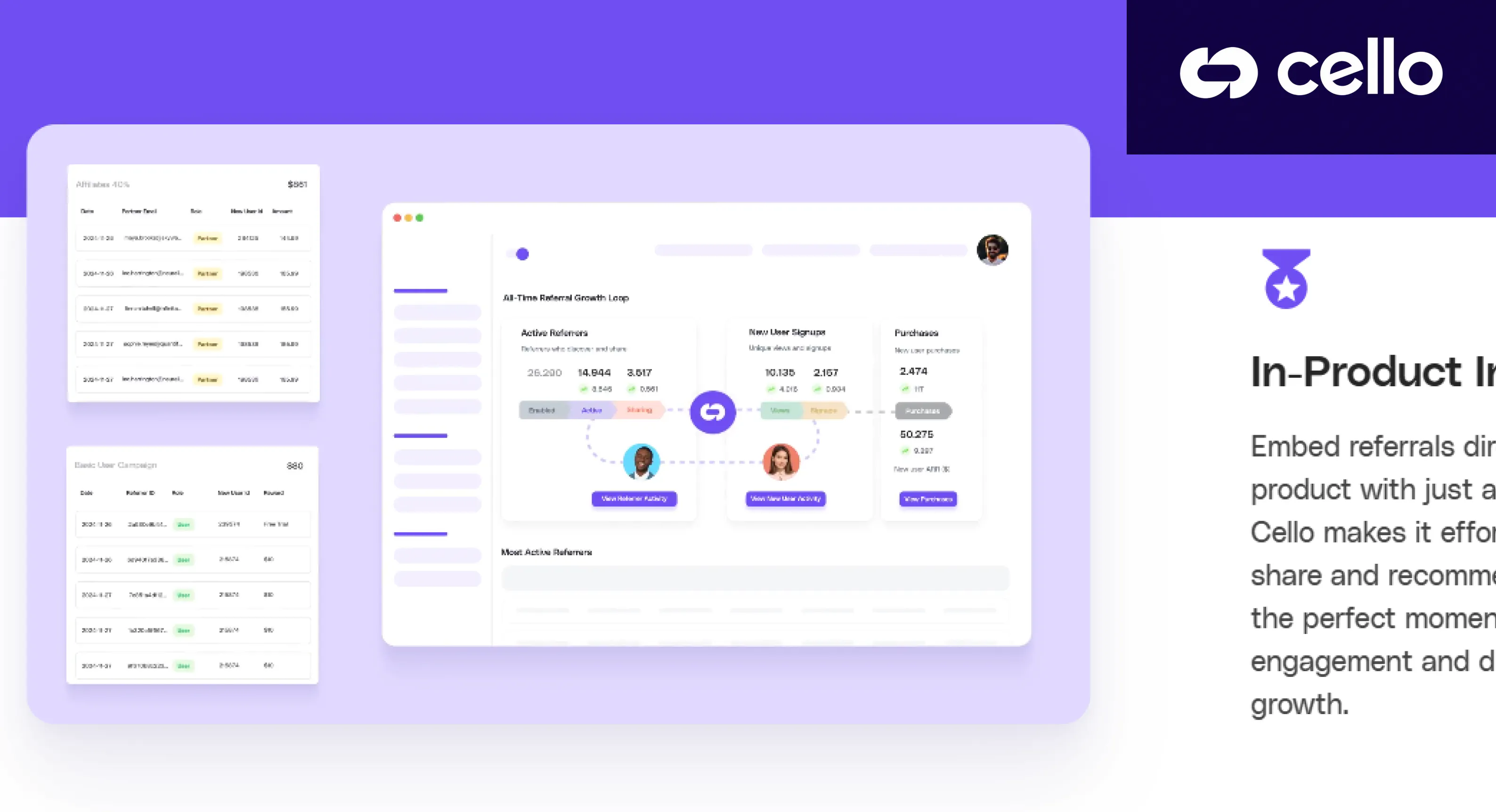
Companies using platforms such as Cello are increasingly building referral systems directly into the user experience instead of treating them as separate campaigns.
For a deeper explanation of growth loops, Viral Loops provides an excellent resource: blog-growth loops
Why Most SaaS Referral Programs Fail
Many referral programs fail because they're designed like marketing widgets instead of product features.
Companies often copy tactics from consumer apps that don't translate well to B2B SaaS. Generic popups appear at random moments. Users aren't prompted after experiencing value. Teams launch referral programs without tracking performance metrics.
Execution problems are also one of the reasons many promising SaaS products struggle to gain traction.
Referral systems work because they align with human behavior.
People naturally trust recommendations from colleagues and friends more than advertisements. Mutual rewards create reciprocity. Exclusive benefits create status. And the easier it is to share, the more likely users are to do it.
The best referral systems appear immediately after users experience value.
That principle is central to the user-led growth approach promoted by Cello. Instead of interrupting users, referrals become a natural extension of the product.
Designing a Referral Program That Converts
Choose Incentives That Match Your Product
Rewards should strengthen your product rather than distract from it.
Many SaaS companies offer usage credits, premium features, additional seats, or extended access. These rewards encourage long-term engagement and improve retention.
Heavy cash rewards may increase participation, but they often attract lower-quality users.
Referral incentives should also align with your roadmap and overall business goals.
Users are most likely to share your product immediately after accomplishing something meaningful. Collaboration moments, milestone achievements, and successful actions create ideal opportunities.
For example:
"You've reached 80% usage. Invite a teammate and unlock additional access."
Remove Friction Wherever Possible
The easier it is to share, the faster growth compounds.
Platforms like Cello focus heavily on one-click sharing, reward automation, and native integrations because reducing friction has a significant impact on referral participation.
Users should always understand what they'll receive and how rewards work.
Measure What Matters
Without measurement, optimization becomes impossible.
Tracking invite volume, conversion rates, activation rates, and the time required for users to send their first invite helps identify bottlenecks in the referral loop.
Every successful growth engine depends on continuous iteration.
Expand Gradually
The strongest referral programs rarely launch with complicated reward systems.
Many companies begin with a simple "invite one user and receive a reward" model. Once the foundation proves successful, they introduce tiered rewards, partner programs, and affiliate incentives.
Dropbox became famous for its double-sided referral system. Both users received additional storage, making referrals feel valuable instead of transactional.
This approach played a major role in the company's rapid expansion.
Notion combined referral programs with affiliate partnerships.
This strategy expanded awareness beyond existing customers and created multiple acquisition channels.
A Step-by-Step Plan to Reach 1,000 Users
The first two weeks should focus on building the foundation. Define your activation event, choose rewards, implement referral prompts, and establish tracking.
During weeks three and four, launch the program to your most engaged users. Test messaging and analyze the results.
By weeks five and six, roll out referrals to all customers. Include referral messaging in onboarding and reinforce trust through testimonials and social proof.
Between weeks seven and ten, introduce tiered rewards, strategic partnerships, and optimization experiments.
These metrics provide a framework for understanding whether your referral engine is improving over time.
Tools to Build Your Referral Program
Several platforms can help SaaS companies launch and manage referral programs.
Cello has emerged as one of the leading user-led growth platforms for SaaS businesses. It combines customer referrals and partner programs while automating attribution and rewards.
GrowSurf helps SaaS companies create and manage referral programs with automated tracking and reward distribution. It offers customizable campaigns and analytics to measure referral performance.
Viral Loops provides referral and viral marketing software inspired by successful growth campaigns. It enables businesses to launch referral programs quickly using pre-built templates.
ReferralCandy is designed to automate referral programs and reward customers for bringing in new users. It is widely used by e-commerce brands and subscription businesses.
FirstPromoter is a referral and affiliate tracking platform built for SaaS companies. It helps businesses manage ambassadors, commissions, and recurring rewards efficiently.
Rewardful enables SaaS companies to run affiliate and referral programs with seamless integrations and automated payouts. It is particularly popular among Stripe-based businesses.
If you're building custom workflows internally, Beyond Labs offers AI automation services. The company helps businesses automate repetitive processes and build intelligent workflows tailored to their operations.
Learn From Experts
Word-of-Mouth Referrals on Autopilot
This video explains how SaaS companies can embed referral programs directly into their products and create scalable user-led growth loops.
Growth Loops Explained
Referral Marketing for SaaS
These resources provide practical frameworks and examples that can help improve your referral strategy.
Frequently Asked Questions
When should a SaaS company launch a referral program?
Most companies begin experimenting after reaching their first 100 users and achieving consistent product usage.
What rewards work best?
Usage credits, premium features, and additional seats generally outperform cash incentives because they reinforce product engagement.
What is a good viral coefficient?
Early-stage SaaS companies often target a viral coefficient between 0.3 and 0.6. Strong retention can still create substantial growth even below one.
Can B2B SaaS companies benefit from referrals?
Absolutely. Collaboration tools and team-based software naturally encourage users to invite coworkers and stakeholders.
Final Thoughts
A SaaS referral program isn't just another marketing tactic.
When built correctly, it becomes part of the product itself.
Platforms like Cello are built around that philosophy, helping SaaS companies automate referrals, rewards, and attribution while creating growth loops that compound over time.
That's how companies move from 100 users to 1,000 users—and eventually to growth that scales itself.
Beyond Labs LLC provides the information on this website for general informational purposes only and nothing herein constitutes professional, legal, financial, investment, or contractual advice, nor does it create a client relationship; all services are governed exclusively by executed written agreements. While we strive for accuracy, we make no representations or warranties, express or implied, regarding the completeness, reliability, or results of any content, case studies, or materials presented, and past performance does not guarantee future outcomes. References to third-party brands, platforms, or technologies are for descriptive purposes only and do not imply partnership, endorsement, or affiliation unless expressly stated in writing. Beyond Labs operates as an independent consultancy and disclaims liability to the fullest extent permitted by law for any reliance placed on website content. We reserve the right to modify this Disclaimer at any time, and continued use of this website constitutes acceptance of the updated terms.
Beyond Labs is a registered trademark of Beyond Labs, LLC. All third-party names, logos, and brands mentioned on this site are the trademarks of their respective owners. Beyond Labs, LLC is an independent entity with no endorsement, sponsorship, or affiliation with these third parties. Any use of third-party names, logos, or brands is solely for identification purposes and does not imply endorsement or partnership.